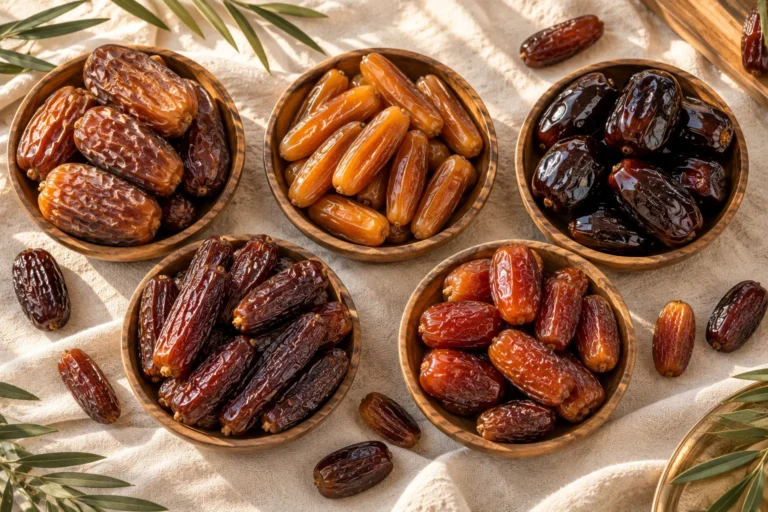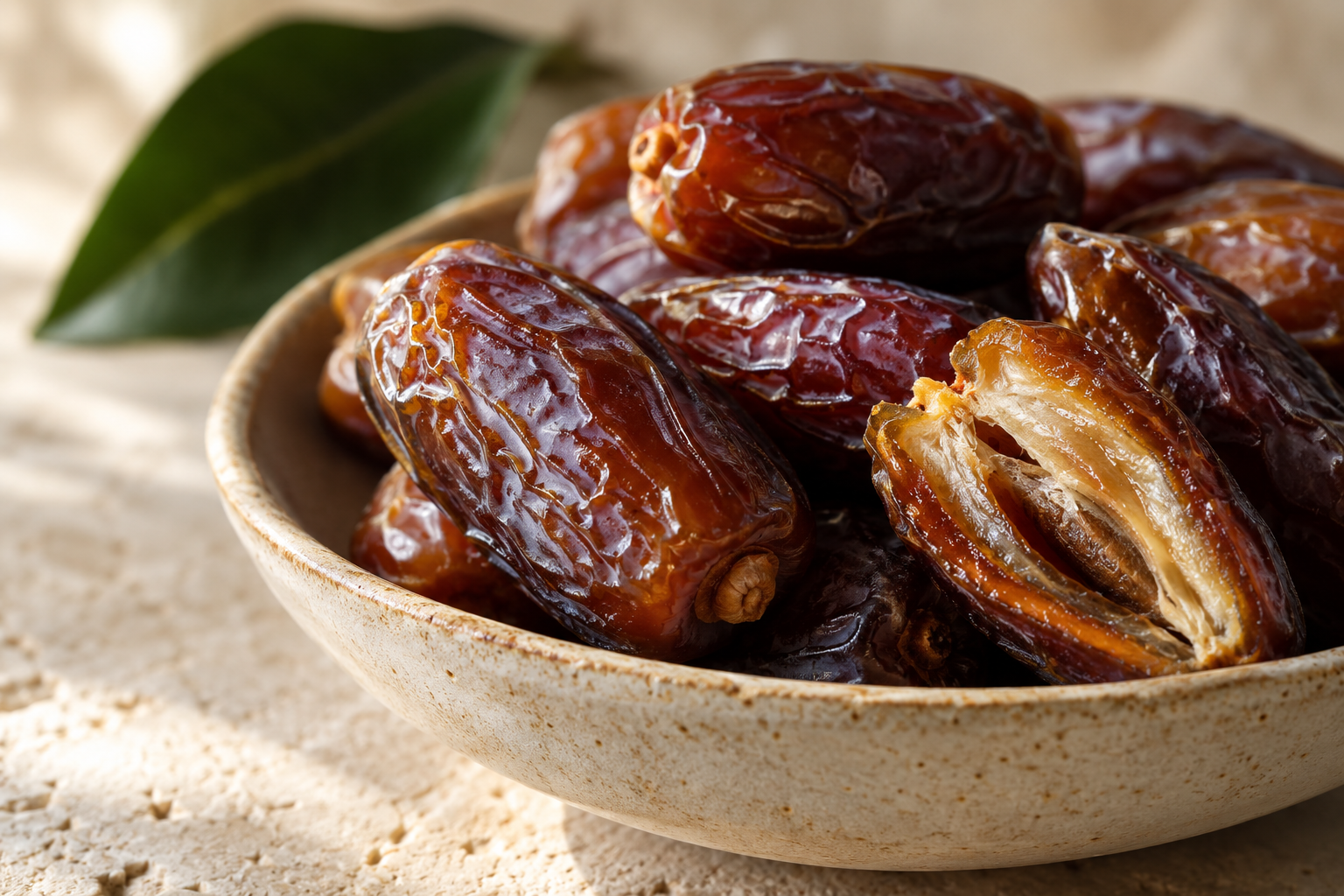
Date storage is the difference between a lot that sells at full value and one that is discounted six months later for darkening, sugaring or a live insect finding. Dates arrive as a finished food rather than an ingredient waiting to be processed, so everything that happens after harvest happens in the warehouse — and the fruit keeps changing there, slowly, in every facility it passes through.
This guide covers how long dates keep, the temperature and moisture limits that matter, how to disinfest a lot properly, and the storage defects that generate the most rejections in the trade.
What decides how long dates can be stored
Most buyers ask about cold storage first. It is the second question. The first is how much water the fruit is carrying, because moisture determines what temperature the lot will actually need.
Dates are traded in three broad moisture classes, and they do not behave the same way in storage:
| Class | Typical moisture | Common varieties | Storage behaviour |
|---|---|---|---|
| Soft | Above 20% | Medjool, Barhi, Halawy | Most perishable — needs cold or frozen storage |
| Semi-dry | 15–20% | Deglet Noor, Zahidi, Sayer | Stable for months at cool temperatures |
| Dry | Below 15% | Thoory and similar | Very stable; risk is hardening, not spoilage |
The more useful figure, however, is not moisture percentage but water activity — the water actually available to microorganisms rather than the total water present. As a working rule, moulds are effectively inhibited below about 0.70 aw, and osmophilic yeasts — the organisms responsible for sour, fermented dates — become inactive below roughly 0.65 aw. Two lots can show the same moisture reading and behave differently because their sugar composition binds water differently.
Moisture tells you what the lot contains. Water activity tells you what the lot will do.
If a supplier cannot state water activity, ask for it before signing a long-term contract. It costs nothing to measure and it is the single number that predicts spoilage.
Date storage temperature: chilled, frozen or ambient
Once moisture is known, temperature decides how long quality holds. The chemistry that darkens dates — non-enzymatic browning between reducing sugars and amino acids — roughly doubles in rate with every 10°C increase. That one relationship explains most of what happens in a warehouse.
| Temperature | Indicative holding period | Typical use |
|---|---|---|
| 20–25°C (ambient) | Weeks to a few months | Fast-moving stock, dry varieties only |
| 0–5°C (chilled) | Six to twelve months | Standard for semi-dry and soft varieties |
| −18°C (frozen) | Twelve to twenty-four months | Premium soft dates, carry-over stock, off-season supply |
Two practical notes on freezing dates. First, they freeze without ice-crystal damage because of their high sugar content, which is why the texture survives thawing far better than most fruit. Second, thawing must be gradual and, ideally, still inside the sealed packaging — moving cold fruit straight into warm air draws condensation onto the surface, and surface moisture is exactly what mould needs.

Stability beats the set point
A warehouse that cycles between 4°C and 15°C causes more damage than one that holds steady at 12°C. Each cycle moves moisture within the pack, drives condensation onto the coldest surfaces, and accelerates sugar crystallisation. When comparing storage facilities, ask for temperature logs — not the set point on the controller.
Humidity and packaging work as one system
Ambient relative humidity around 65–70% suits most semi-dry dates in storage. Below that, the fruit loses moisture, hardens and develops the white bloom buyers often mistake for mould. Above it, the surface picks up water and the risk shifts to fermentation.
In practice the warehouse rarely controls humidity precisely enough on its own. The packaging does the work:
- Food-grade liners. A polyethylene liner inside the carton isolates the fruit from ambient swings and is the minimum for bulk storage.
- Vacuum or modified atmosphere. Replacing headspace air with nitrogen or carbon dioxide slows oxidative darkening and suppresses insect activity at the same time.
- Barrier film. For frozen and long-hold stock, films are selected for water vapour transmission rate rather than appearance.
- Outer carton. Protects against compression at the bottom of a pallet — soft varieties deform under load and the damage is permanent.
Disinfest the lot before it goes into storage
Infestation is rarely a storage failure. It is almost always a failure to disinfest at intake. The usual pests are the almond moth (Ephestia cautella), the saw-toothed grain beetle (Oryzaephilus surinamensis) and dried fruit beetles of the Carpophilus genus. Eggs frequently arrive with the fruit from the field, which is why post-harvest handling guidance from bodies such as the FAO treats disinfestation as a standard step rather than a corrective one.
Three treatments are common, and the right one depends on the destination market:
- Freezing. Holding the lot at −18°C for 48–72 hours kills all life stages. Clean, residue-free, accepted everywhere — and the reason many operations freeze on arrival regardless of the final storage plan.
- Controlled atmosphere. High CO2 or low-oxygen treatment over several days. Slower, but no residues and compatible with organic certification.
- Fumigation. Effective and fast, but tightly regulated, restricted in several destinations and unsuitable for organic lots. Confirm acceptance in the destination market before treating.
Whatever the method, the treated lot must go straight into a sealed pack. Disinfested fruit stored in an open carton beside untreated stock will be re-infested within weeks.
Warehouse practice that actually changes outcomes
The fundamentals are unglamorous and they account for most avoidable loss:
- Pallets kept clear of walls and off the floor, with airflow between rows.
- Strict first-in, first-out rotation, with the crop year marked on the pallet label — not only on the paperwork.
- Data loggers placed inside pallets, not on the wall. The temperature at the centre of a stacked pallet is the temperature that matters.
- No shared storage with strongly aromatic goods. Dates absorb odours readily, and spices, coffee and cleaning chemicals all transfer.
- Sampling on a schedule — a small sample drawn monthly and checked for water activity, colour and live insects catches problems while they are still correctable.
Transport is storage, at a worse temperature
A lot held perfectly for eight months can lose a grade in three weeks at sea. Container interiors regularly exceed 40°C in transit, and that heat undoes months of careful holding.
For soft varieties, a refrigerated container at 0–5°C is the only reliable answer, and the cost usually returns itself in avoided claims. For semi-dry varieties in an ambient container, the practical protections are insulation liners, positioning away from the container walls, desiccant to control condensation, and — where the route allows it — avoiding the hottest sailing window rather than trying to compensate for it.
Common date storage defects and their causes
| Defect | Appearance | Usual cause |
|---|---|---|
| Darkening | Progressive browning, dull surface | Storage temperature too high, held too long |
| Sugaring | White crystalline bloom, gritty texture | Low humidity, temperature cycling, high-glucose variety |
| Souring | Fermented smell, sticky surface | Water activity above roughly 0.65; yeast activity |
| Mould | Visible growth, musty odour | Surface condensation, wet packaging, poor airflow |
| Hardening | Dry, tough texture | Moisture loss through inadequate barrier packaging |
| Infestation | Webbing, holes, live insects | No disinfestation at intake, or re-infestation in open packs |
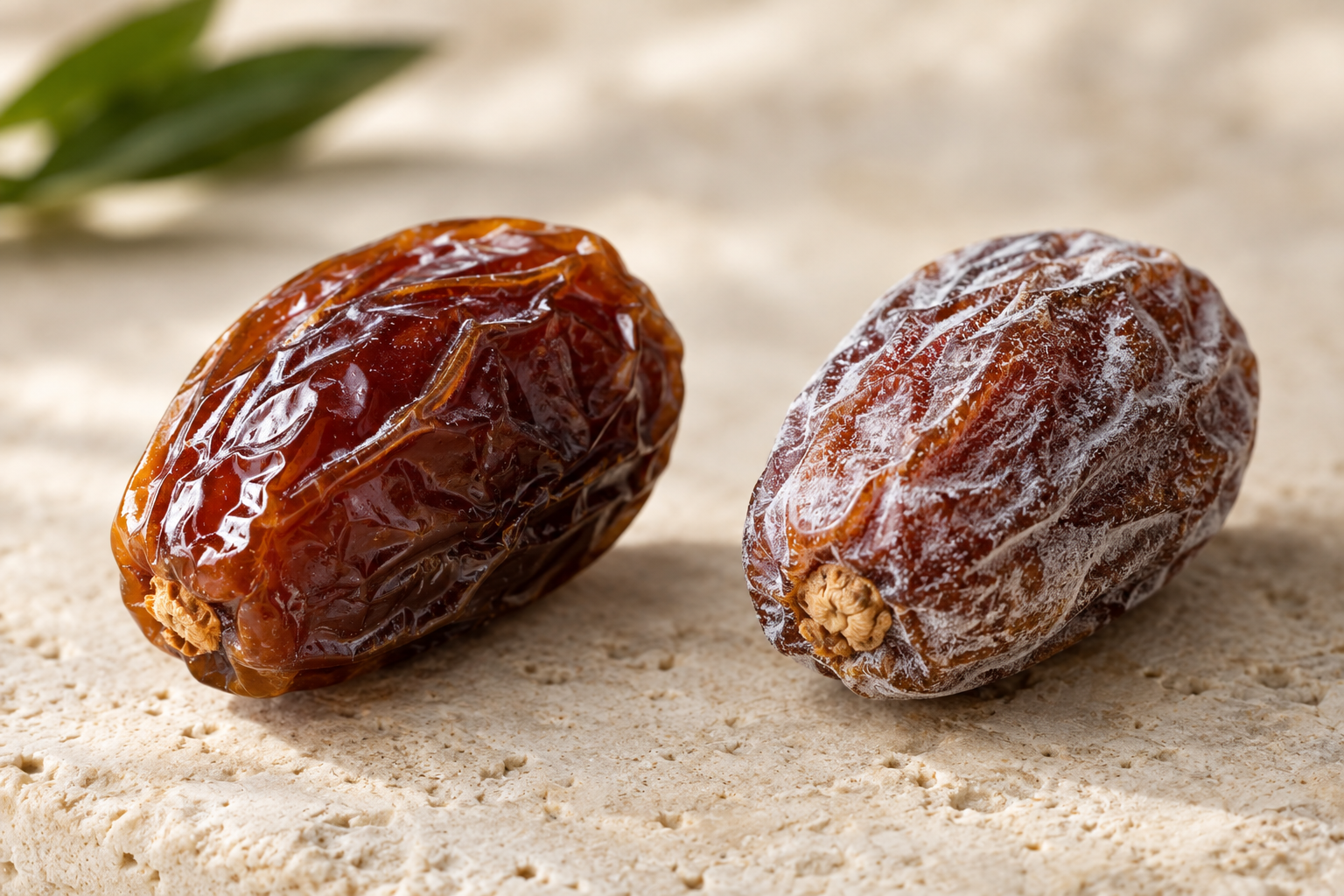
Sugaring deserves a note, because it generates more rejections than it should. It is a physical change — glucose crystallising out of the fruit’s own sugars — not a safety issue. The lot is perfectly edible, but it will not pass a retail specification. Buyers writing a specification for retail packs should state this explicitly rather than assuming it is covered.
A practical storage plan by variety
Medjool and other soft dates
Freeze on arrival at −18°C, both to disinfest and to hold. Move to 0–4°C for working stock only, in quantities that will clear within four to six weeks. Ship refrigerated. This is the most expensive route and the only one that reliably protects a premium Medjool specification.
Deglet Noor and semi-dry varieties
Chilled storage at 0–5°C with a liner and sealed carton holds quality through a full season. Disinfest at intake. Ambient shipping is workable with insulation and desiccant, provided the transit avoids peak summer temperatures.
Zahidi and dry varieties
The most forgiving class. Cool, dry, well-ventilated storage is usually sufficient, and the real risk is moisture loss rather than spoilage. Barrier packaging matters more than refrigeration here.
Frequently asked questions
How long can dates be stored?
Six to twelve months at 0–5°C, and twelve to twenty-four months at −18°C. At ambient warehouse temperature, expect weeks to a few months depending on the variety and its moisture class.
Should dates be refrigerated or frozen?
Soft varieties such as Medjool should be frozen for holding and chilled only for working stock. Semi-dry varieties such as Deglet Noor hold well chilled. Dry varieties usually need neither, provided the packaging blocks moisture loss.
Is the white coating on dates mould?
Usually not. A fine white bloom is normally sugaring — glucose crystallising at the surface. Mould appears as fuzzy growth with a musty odour and is accompanied by high surface moisture.
What temperature damages dates in shipping?
Sustained exposure above roughly 30°C accelerates darkening noticeably, and container interiors regularly exceed 40°C. For soft varieties, a refrigerated container is the only reliable protection.
Before you commit a lot to long-term storage
- Water activity measured and recorded — not estimated from moisture alone.
- Disinfestation completed and documented, by a method the destination market accepts.
- Packaging sealed, food grade, and matched to the intended holding period.
- Storage temperature confirmed by logger data, not by the facility’s set point.
- Crop year marked on the pallet and rotation enforced.
- A sampling schedule agreed before the lot goes in, not after a problem appears.
None of these steps is expensive on its own. Together they are the difference between selling a lot at its grade and explaining why it no longer meets one.
Plusimpex B.V. supplies dry fruits including dates, apricots, raisins and figs to wholesalers, distributors and food manufacturers across Europe, Asia and the Middle East. If you are planning a season’s requirement and want to discuss specification, storage conditions or shipping mode before committing, get in touch with our team.