Pistachio grades are quoted three different ways in the same offer sheet, and buyers who mix them up pay for it: a “grade” can mean the variety (Akbari, Fandoghi, Kerman), the size count (how many nuts per ounce), or the open-shell percentage (how many nuts a consumer can actually open by hand). A lot described simply as “premium pistachios” tells you almost nothing about what will arrive.
This guide sets out how the trade actually grades pistachios — Iranian, Californian and Turkish — what the size counts mean, how open-shell percentage is measured, and which grade fits retail, roasting, confectionery or ingredient use.
Why “pistachio grade” means three different things
An offer for pistachios should always specify all three parameters. Each one changes the price and the application independently:
| Parameter | What it describes | How it is expressed |
|---|---|---|
| Variety | Shape, flavour, kernel colour, origin | Akbari, Ahmad Aghaei, Kaleh Ghuchi, Fandoghi, Kerman, Antep, Siirt |
| Size count | Number of in-shell nuts per ounce (28.35 g) | 18/20, 20/22, 22/24 … 32/34 — lower numbers are larger nuts |
| Open-shell % | Share of nuts split naturally on the tree | Typically 90–98% for naturally opened; closed shells and blanks stated separately |
A second layer of grading applies to kernels — green kernels, natural kernels, halves and pieces — and is covered further down. But for in-shell pistachios, variety, count and open-shell percentage are the three numbers that decide what a lot is worth.
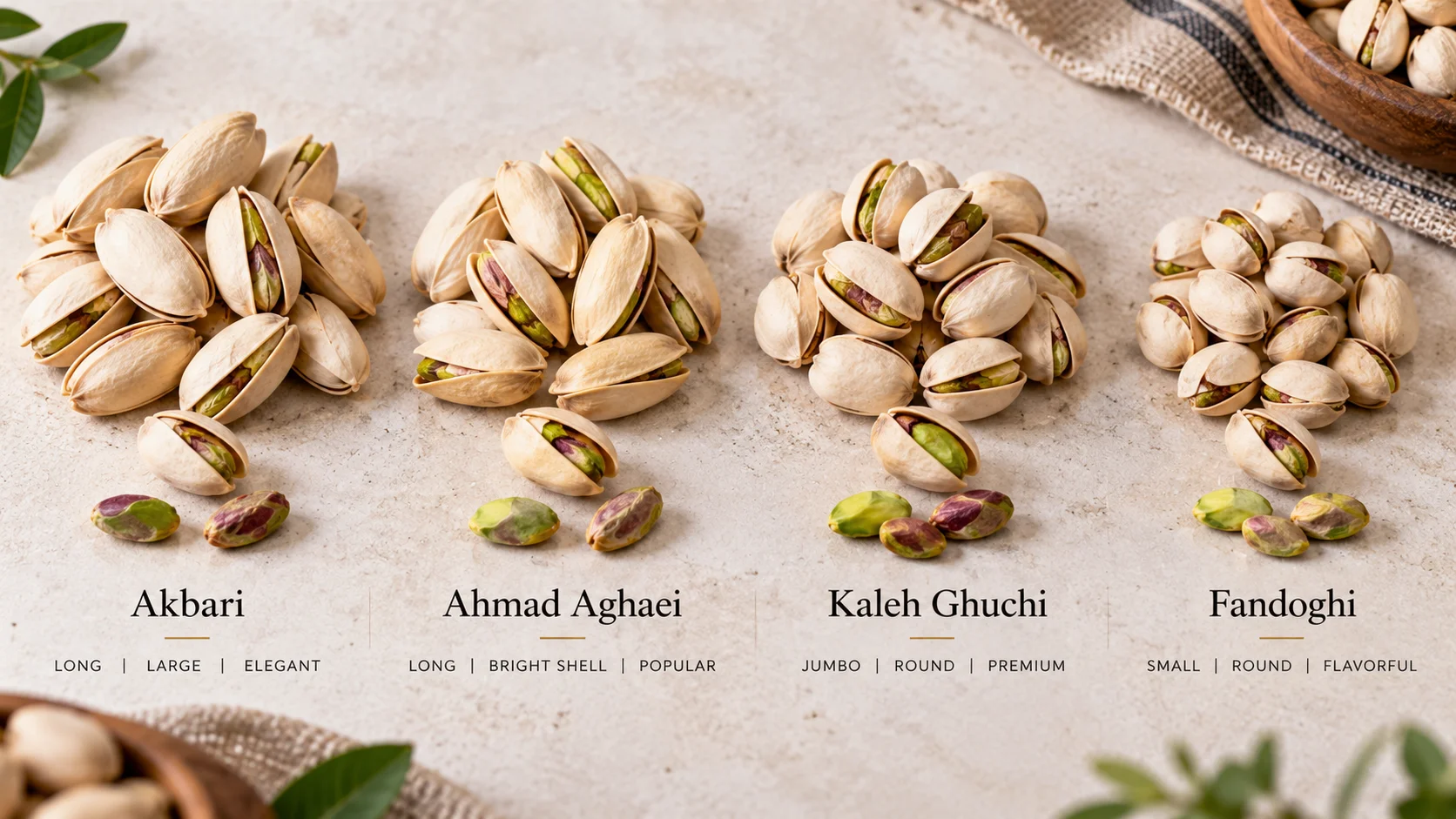
Iranian varieties: Akbari, Ahmad Aghaei, Kaleh Ghuchi and Fandoghi
Iran grows more pistachio varieties commercially than any other origin, and four of them account for almost all exports. They divide into two shapes — long (badami) and round (fandoghi) — and the shape is the first thing a European buyer needs to decide, because retail packs, roasting lines and confectionery each favour a different one.
Akbari
The largest and most expensive Iranian variety. Long, slender, with a distinctive elongated shell and a large, sweet kernel. Usual counts 18/20 to 22/24. Akbari is bought for premium retail packs and gift trays, where the appearance of the individual nut justifies the price. It is rarely used for kernels because the whole nut commands more.
Ahmad Aghaei
Long, with a brighter, whiter shell than Akbari and a strong natural split. Counts 22/24 to 26/28. Ahmad Aghaei roasts and salts particularly well — the open shell takes salt evenly — and it is the workhorse of the roasted-and-salted retail segment. It is often the best value in the long-shape class.
Kaleh Ghuchi
The “jumbo round”: a large, wide nut with a heavy kernel. Counts 20/22 to 24/26. Kaleh Ghuchi is prized for kernel yield and for a visibly large nut in snack packs, but it is more sensitive to closed shells in some crop years, so the open-shell percentage on the certificate matters more here than for other varieties.
Fandoghi
The round, smaller variety that makes up the largest share of Iranian export volume. Counts 28/30 to 32/34. Fandoghi is the standard for roasting, salting, flavouring and for kernels destined for confectionery and ice cream, because the price per kilo of kernel is the lowest of the four and the green colour is consistent. When an offer says only “Iranian pistachios” with no variety, it is usually Fandoghi.
Californian Kerman and Turkish Antep
Kerman (California, USA)
Almost all Californian production is a single variety, Kerman — round, with a pale shell, a mild flavour and a high, mechanically assisted open-shell rate. Grading follows US industry counts (18/20 through 30/32) and the shell is often lighter and more uniform than Iranian fruit, which suits supermarket own-label packs. Kernels are paler green than Iranian kernels; buyers specifying “green kernels” for confectionery usually mean Iranian or Turkish material.
Antep and Siirt (Türkiye)
Turkish pistachios are smaller and grown mainly around Gaziantep and Siirt. Antep pistachios are small, intensely flavoured and dark green — the reference kernel for baklava and Turkish confectionery, where colour and flavour matter more than size. Siirt pistachios are larger and longer, closer to Iranian long varieties, and are sold roasted and salted in shell. Turkish counts are quoted per 100 g rather than per ounce, so ask for a conversion when comparing with Iranian or Californian offers.
For a snack pack, choose by shape and count. For a confectionery recipe, choose by kernel colour and price per kilo of kernel. They are different purchases.
Size counts explained: 18/20 to 32/34
The count is the number of in-shell nuts in one ounce (28.35 g). A count of 20/22 means between 20 and 22 nuts per ounce; a count of 30/32 means 30 to 32. The smaller the number, the bigger the nut — and, all else equal, the higher the price.
| Count (per oz) | Nuts per 100 g (approx.) | Typical varieties | Usual application |
|---|---|---|---|
| 18/20 – 20/22 | 63–78 | Akbari, Kaleh Ghuchi, Kerman jumbo | Premium retail, gift packs |
| 22/24 – 24/26 | 78–92 | Ahmad Aghaei, Kaleh Ghuchi, Kerman large | Roasted & salted retail, food service |
| 26/28 – 28/30 | 92–106 | Ahmad Aghaei small, Fandoghi large, Kerman | Standard retail packs, mixed nuts |
| 30/32 – 32/34 | 106–120 | Fandoghi | Roasting, flavouring, kernel production |
Two things to check on a certificate. First, whether the count was measured on the whole lot or on a sample after sorting — a lot quoted “22/24” with 8% undersize mixed in will not look like 22/24 on the shelf. Second, the moisture at which the count was taken: pistachios lose weight as they dry, so a count measured on freshly hulled fruit shifts upward after drying to the standard 4–6% moisture.
Open-shell percentage, closed shells and blanks
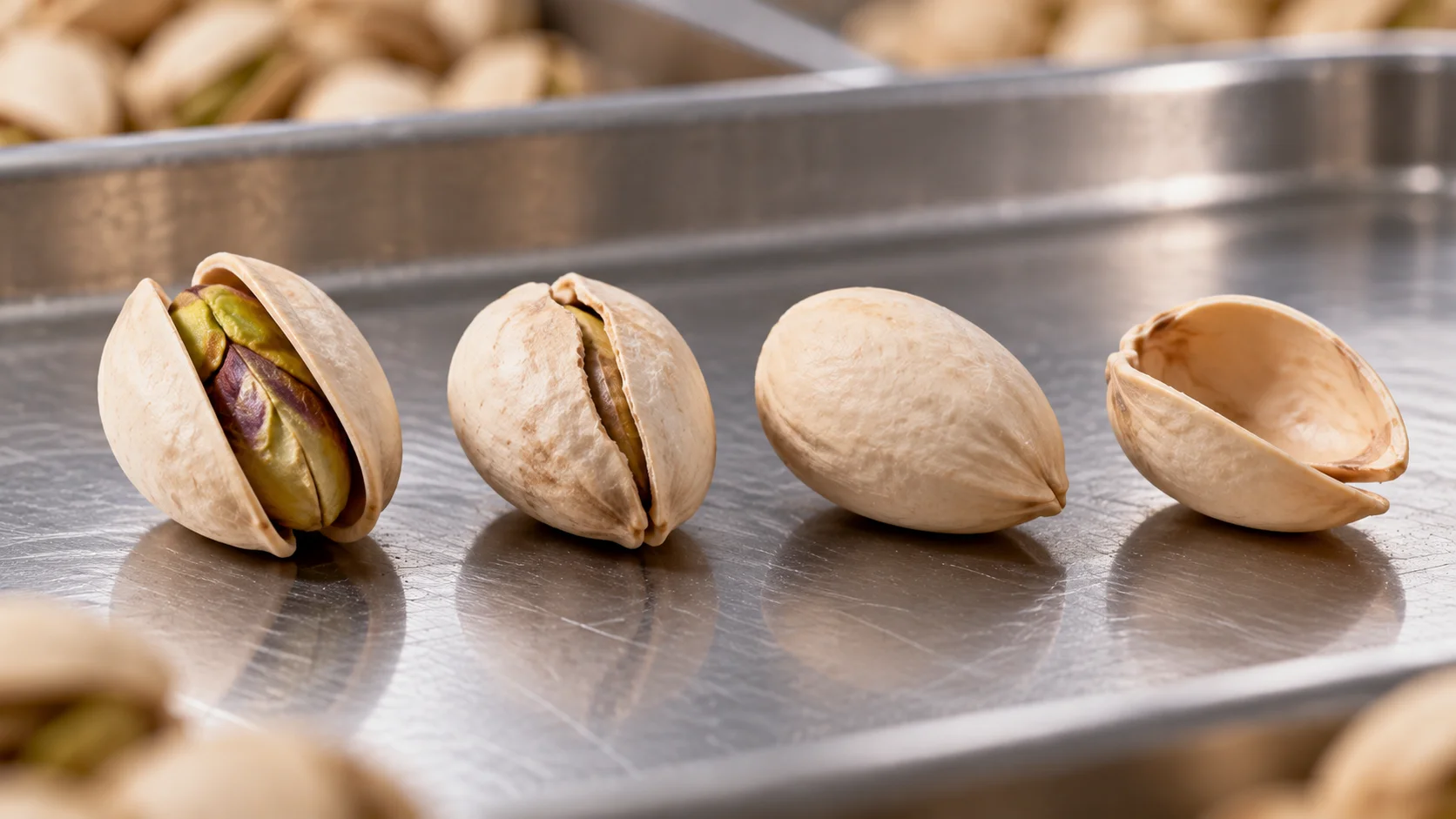
Pistachios split on the tree as the kernel grows and pushes the shell apart. A nut that has split naturally can be opened by hand and is what retail consumers expect. The trade therefore grades in-shell pistachios by three fractions:
- Naturally opened. Split on the tree; the shell shows a clean, wide opening. Export lots are usually sold at 90%, 95% or 98% open. Higher percentages cost more because they require more sorting.
- Mechanically opened. Closed nuts passed through a machine that cracks the shell along the seam. Cheaper, but the opening is narrower and less regular, and the nuts are more likely to break in roasting. Acceptable for some flavoured and food-service lines; not for premium retail.
- Closed shells. Nuts that did not split and were not mechanically opened. Tolerance in a good lot is 2–5%; buyers should specify a maximum.
- Blanks. Empty shells with no kernel. They weigh little, float in water and are removed by flotation at the processor — a lot with more than 1–2% blanks was not properly processed.
Ask for the open-shell percentage on the certificate of analysis and specify a maximum for closed shells and blanks. “Naturally opened, 95% minimum, closed max 3%, blanks max 1%” is a complete in-shell specification; “premium open pistachios” is not.
Kernels vs in-shell: which grade for which application
Roughly half the world’s pistachio volume is traded in shell and the rest as kernels. The grade language changes with the form:
| Form | Grade terms | Best-suited varieties | Main applications |
|---|---|---|---|
| In-shell, raw | Count, open-shell %, closed, blanks | All; long varieties for premium packs | Roasters, retail packers |
| In-shell, roasted & salted | Count, roast level, salt %, flavour | Ahmad Aghaei, Fandoghi, Kerman, Siirt | Supermarket, ethnic retail, food service |
| Natural kernels | Whole %, halves, colour (green/yellow), skin on/off | Fandoghi, Kerman | Bakery, snack bars, nut butters, mixes |
| Green kernels (peeled) | Green %, size, peeled/unpeeled | Antep, Fandoghi, immature-harvest lots | Baklava, confectionery, ice cream, pistachio paste |
| Slivers, diced, flour | Cut size (mm), colour | Antep, Fandoghi | Topping, inclusions, fillings |
Green kernels deserve a note. The deep green colour that confectioners want comes from harvesting slightly early and from specific varieties; it is not a processing effect. A supplier offering “green kernels” from Kerman or fully mature Akbari is offering a pale kernel with a green name. Request a colour photo of the actual lot, or a sample, before contracting for baklava or ice-cream use.
Quality and aflatoxin: what to ask the supplier
Pistachios are one of the commodities the EU tests most intensively for aflatoxin, and a lot that fails at the border is a total loss regardless of its grade. Under Regulation (EU) 2023/915 the limits for pistachios intended for direct consumption are 8 µg/kg aflatoxin B1 and 10 µg/kg total aflatoxins; lots that will still be sorted or processed before consumption are allowed 12 and 15 µg/kg respectively. Iranian and Turkish pistachios are subject to increased official controls at EU border control posts, so the sampling and lab report from origin must follow the EU method (Regulation 401/2006) or the goods will be resampled on arrival.
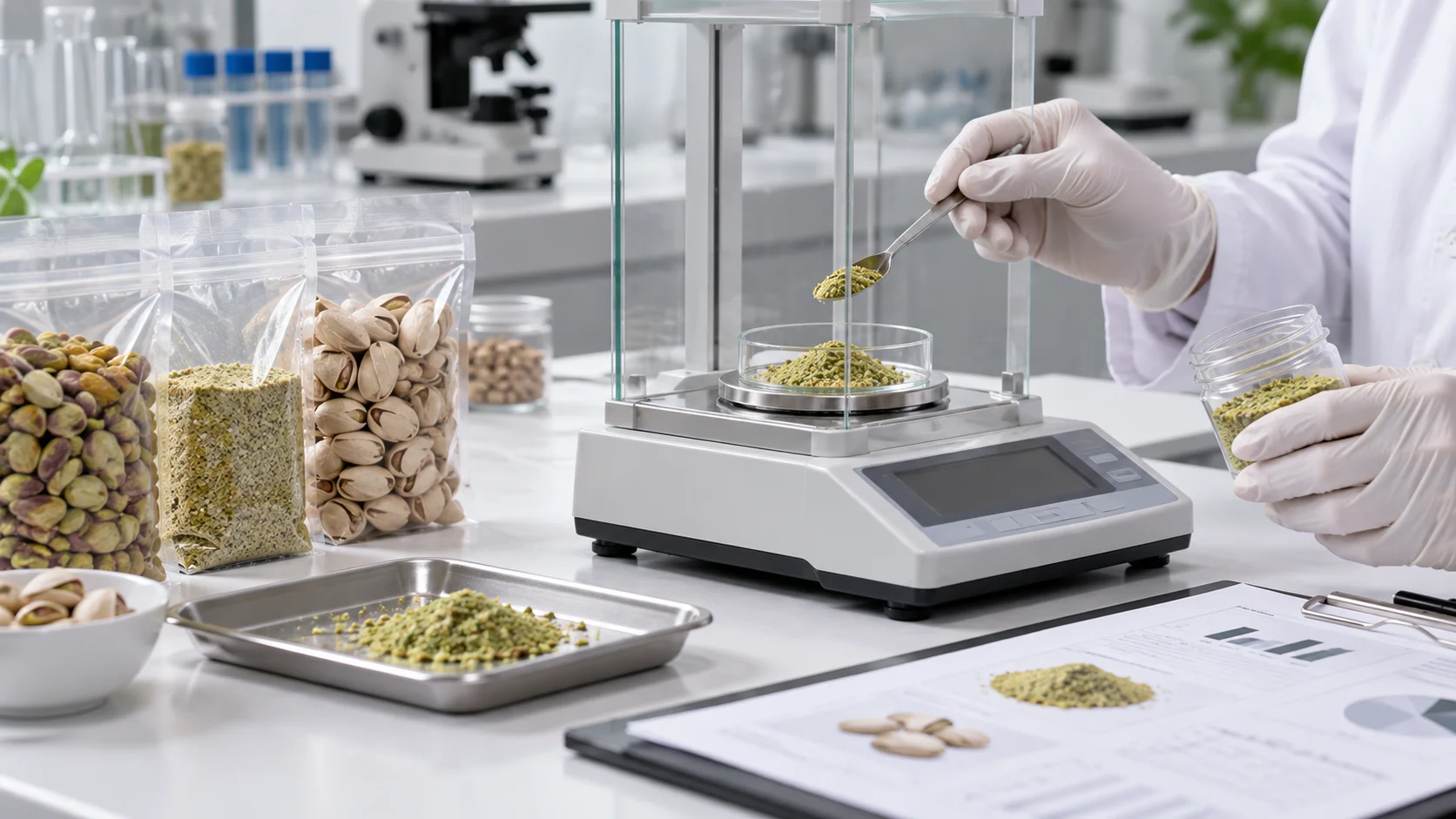
Beyond aflatoxin, a complete pistachio specification should state:
- Moisture (typically 4–6%) and water activity.
- Free fatty acid and peroxide value — the indicators of rancidity in kernels.
- Foreign matter, shell fragments (for kernels) and insect damage limits.
- Crop year, and whether the lot is new crop or carry-over.
- Treatment: raw, roasted, salted, flavoured; disinfestation method used.
- Packing: 10–12.5 kg cartons with liner, 25 kg sacks, or vacuum bags for kernels.
Ask for these before price. A supplier who can quote a count and an open-shell percentage but not an aflatoxin result is quoting a lot that has not been tested — and the price will look very good for exactly that reason.
Quick comparison table
| Variety | Origin | Shape | Usual counts | Kernel colour | Best use |
|---|---|---|---|---|---|
| Akbari | Iran | Long, large | 18/20 – 22/24 | Yellow-green | Premium retail, gifts |
| Ahmad Aghaei | Iran | Long | 22/24 – 26/28 | Green-yellow | Roasted & salted retail |
| Kaleh Ghuchi | Iran | Jumbo round | 20/22 – 24/26 | Green | Snack packs, kernels |
| Fandoghi | Iran | Round, small | 28/30 – 32/34 | Green | Roasting, kernels, confectionery |
| Kerman | USA (California) | Round | 18/20 – 30/32 | Pale green | Own-label retail, mixes |
| Antep | Türkiye | Small, oval | Per 100 g | Deep green | Baklava, confectionery, paste |
| Siirt | Türkiye | Long | Per 100 g | Green | Roasted & salted in shell |
Frequently asked questions
Which pistachio grade is best for roasting and salting?
Ahmad Aghaei (22/24–26/28) and Fandoghi (28/30–32/34) from Iran, Kerman from California and Siirt from Türkiye all roast well. The open shell must be wide enough to take salt evenly, so specify naturally opened, 95% minimum, rather than mechanically opened lots.
What does 22/24 mean on a pistachio offer?
Twenty-two to twenty-four in-shell nuts per ounce (28.35 g), or roughly 78–85 nuts per 100 g. It is a size grade: the lower the numbers, the larger the nut.
What is the difference between Iranian and Californian pistachios?
Iran grows several varieties in long and round shapes with darker green, more strongly flavoured kernels; California grows almost only Kerman, a round, pale-shelled, mild variety with a very uniform appearance. Iranian fruit is preferred for flavour and green kernels; Californian for uniform own-label retail packs.
What open-shell percentage should I specify?
For retail packs, 95% naturally opened with closed shells at a maximum of 3% and blanks at a maximum of 1%. For roasting lines that can tolerate some breakage, 90% is common. Avoid unspecified “open” lots, which may be mechanically opened.
What is the EU aflatoxin limit for pistachios?
Under Regulation (EU) 2023/915: 8 µg/kg aflatoxin B1 and 10 µg/kg total for pistachios intended for direct consumption; 12 µg/kg B1 and 15 µg/kg total for lots that will be sorted or processed before consumption. Lots from Iran and Türkiye face increased official controls at the EU border.
Before you contract a pistachio lot
- Variety named — not just “Iranian” or “premium”.
- Count stated and measured after drying, with an undersize tolerance.
- Open-shell percentage, closed-shell maximum and blanks maximum on the certificate.
- Aflatoxin result from an accredited laboratory, sampled to EU method.
- Moisture, FFA and peroxide value for kernels.
- Crop year and a physical sample of the actual lot, not a type sample.
Plusimpex B.V. supplies pistachio kernels and in-shell pistachios — Akbari, Ahmad Aghaei, Fandoghi, Kerman and Antep — raw, roasted and salted, to distributors, roasters and food manufacturers across Europe, with aflatoxin analysis and full documentation for EU border control. To discuss a grade, a count or a season’s programme, get in touch with our team.