Ramadan 2027 Dates: A Sourcing Guide for European Importers
Ramadan 2027 dates have to be contracted long before the first fast. Ramadan 1448 is expected to begin on or around 8 February 2027, with Eid al-Fitr about thirty days later. The exact start depends on the moon sighting, but the commercial calendar does not wait for it: European retail buyers finalise their assortments months ahead, and a container that clears customs in the second week of Ramadan has missed the season it was bought for.
That makes sourcing a backwards-planning exercise. This guide starts at the shelf and works back through transit, production and contracting, so you can see which decisions on your Ramadan 2027 dates are already due and which still have room.
Why the season is shorter than it looks
Dates sell year-round in Europe, but the Ramadan peak concentrates a disproportionate share of annual volume into a few weeks. Three things compress the window further:
- Retail listing deadlines run ahead of the season. Supermarket category reviews for a February start are typically closed in the autumn. If you are supplying retail, the decision was made before your order was.
- Demand peaks before Ramadan, not during it. Households buy ahead. Wholesale offtake climbs in the two to three weeks before the first fast and softens well before Eid.
- Ramadan moves earlier every year. It shifts roughly eleven days annually, so each season’s deadline arrives sooner than the one you planned against last time. A team working from last year’s calendar is structurally late.
The backwards timeline for Ramadan 2027 dates
Work from the date your stock has to be sellable in the Netherlands, then subtract. For a Ramadan starting 8 February 2027, goods should be cleared and in the warehouse by mid-January — three to four weeks of buffer for customs, inspection and onward distribution.
| Step | Indicative duration | Latest start for Ramadan 2027 |
|---|---|---|
| Sample approval and specification agreed | 2–3 weeks | Early October 2026 |
| Private-label artwork, print and pack production | 6–10 weeks | Mid-October 2026 |
| Contract, L/C or payment terms settled | 1–2 weeks | Late October 2026 |
| Packing, disinfestation and loading at origin | 2–4 weeks | Early November 2026 |
| Sea freight, Middle East origins to Rotterdam | 25–35 days | Late November 2026 |
| Sea freight, North African origins to Rotterdam | 8–14 days | Mid-December 2026 |
| Customs clearance and border inspection | 3–10 days | Early January 2027 |
| Distribution to wholesale and retail customers | 1–2 weeks | Mid-January 2027 |
Durations are indicative and vary by origin, carrier, port congestion and whether the lot is inspected. Treat them as planning figures, not guarantees.
Read that table from the bottom and one thing becomes clear: for anything shipping from a Middle Eastern origin in standard sea freight, the practical order deadline is late November 2026. Private label pushes it back to October, because the packaging has to exist before the fruit can go into it.
Choosing the variety before you choose the price
Ramadan demand is not one product. The fruit that moves through an ethnic wholesale channel is rarely the fruit a supermarket lists for a gifting display, and the two differ in moisture class, pack format and price band. Buying the wrong one cheaply is the most expensive mistake in this category.
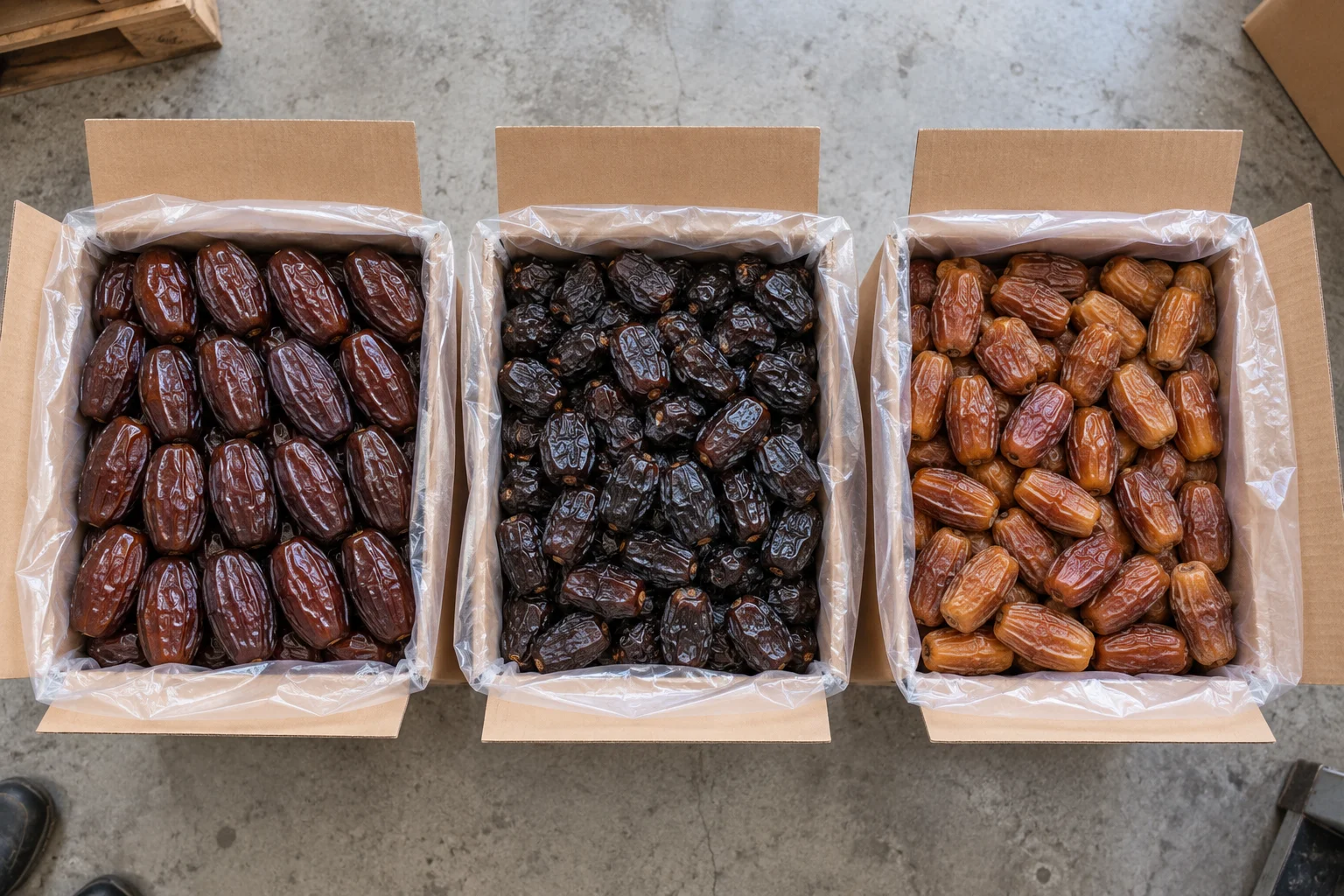
| Variety | Class | Typical channel | Common bulk pack | Notes for Ramadan |
|---|---|---|---|---|
| Medjool | Soft | Retail, premium gifting | 5 kg / 10 kg cartons, graded by size | Highest price band; size grade drives the listing |
| Mazafati | Soft | Ethnic wholesale, food service | 5 kg cartons, chilled chain | Strong demand in NL/BE; needs cold storage throughout |
| Piarom | Semi-dry | Specialty retail | 5 kg cartons | Distinctive, lower-volume; niche listings |
| Deglet Nour | Semi-dry | Retail, branch and loose | 5 kg / 10 kg cartons | Ambient-tolerant; the volume workhorse |
| Sayer / Zahidi | Semi-dry to dry | Industrial, paste and syrup | 10 kg cartons, bulk bins | Priced per function, not per appearance |
Pitted and processed formats sit on a separate timeline again: pitting adds a production step and a yield loss, so it needs to be specified at contract stage rather than requested once the lot is packed. The same applies to organic and to any certification that has to travel with the goods.

Documentation that decides whether the container moves
Paperwork is where otherwise well-planned Ramadan shipments stall, because every document has its own issuing party and none of them can be produced retroactively:
- Halal certification — increasingly expected in this channel even though dates are inherently permissible. Confirm the certifying body is recognised in your destination market, not merely valid at origin.
- Phytosanitary and health certificates — issued at origin, tied to the specific lot and shipment date.
- Pesticide residue and contaminant testing — against EU maximum residue levels. Ask for the report before shipment, not after arrival.
- Disinfestation record — the treatment method matters for organic lots and for markets that restrict fumigants.
- Labelling — EU food information rules, including the country of origin, allergen statement where relevant and correct net weight declaration.
Build a documentary checklist into the purchase contract rather than the shipping instruction. A missing certificate discovered at the border costs demurrage on top of a missed season.
Plan the tail of the season, not only the peak
Every year, some buyers end Ramadan holding stock they intended to sell during it. Two habits prevent that from becoming a write-off.
The first is buying across moisture classes rather than all-in on soft varieties. Semi-dry lots tolerate ambient conditions and carry into the months after Eid without special handling. The second is planning storage conditions before the container lands — how long a lot holds its grade is decided by temperature stability, water activity and packaging, and our guide on how to store dates for a full season without losing grade covers those limits in detail.
There is also a demand argument for the tail: bakery, energy-bar and health-retail buyers purchase dates as an ingredient on a year-round schedule that has nothing to do with the religious calendar. Carry-over stock in the right class has a second market.
What to do this month
- Fix your volume by variety and channel, and separate retail from wholesale demand rather than forecasting one number.
- Request samples now — sample approval is the step most often compressed, and it is the one that determines everything downstream.
- If you need private label, start artwork this month. Packaging lead time, not fruit availability, is the binding constraint.
- Confirm origin, certification and payment terms in writing before the November shipping window closes.
Plusimpex B.V. supplies dates and other dried fruits in bulk to wholesalers, retailers and manufacturers across Europe, alongside our wider range of food products and ingredients. If you are planning Ramadan 2027 volumes, the useful conversation is the one that happens before the shipping window closes.
Request a quote for Ramadan 2027 dates — tell us the variety, volume and destination market, and we will come back with origin options and a realistic shipping schedule.
Frequently asked questions about Ramadan 2027 dates
When does Ramadan 2027 start?
Ramadan 1448 is expected to begin on or around 8 February 2027, subject to moon sighting, with Eid al-Fitr around 10 March 2027.
What is the latest I can order Ramadan 2027 dates?
For standard sea freight from Middle Eastern origins, late November 2026. North African origins allow until roughly mid-December. Private label requires an October decision because of packaging lead times.
Which dates sell best during Ramadan in Europe?
Medjool dominates premium retail and gifting; Mazafati is strong in ethnic wholesale in the Netherlands and Belgium; Deglet Nour carries the mainstream retail volume. The right choice depends on your channel, not on a single ranking.
Do dates imported into the EU need halal certification?
Dates are inherently permissible, but buyers in this channel increasingly require certification. Confirm that the certifying body is recognised in the destination market.
How long can dates be stored after Ramadan?
Semi-dry varieties hold for six to twelve months chilled, and soft varieties considerably longer frozen. Storage temperature stability matters more than the set point.