Date Varieties: Medjool, Deglet Nour, Mazafati, Piarom and Sayer: Choosing the Right Date for Your Channel
Most date enquiries that reach us name a variety before they name a use. A buyer asks for Medjool because Medjool is the name they know, then discovers halfway through the quotation that the price is double what their shelf can carry, or that the soft variety they ordered needs a chilled chain their distribution network does not have. The variety is rarely the first decision. Texture, cold chain and channel come first, and the variety follows from them.
This guide compares the five varieties that cover the large majority of European B2B demand — Medjool, Deglet Nour, Mazafati, Piarom and Sayer — on the specifications that actually change a quotation: moisture, storage temperature, calibre, pitting, shelf life and landed cost. It is written for importers, wholesalers, retail buyers and manufacturers deciding what to put in a container, not for consumers deciding what to put in a bowl.
Start with texture, not the variety name
The date trade classifies fruit into three texture groups before it classifies by variety, because texture is what determines handling, shelf life and packaging. A buyer who specifies the texture group correctly has already eliminated most of the varieties that would not have worked.
Soft dates carry the highest moisture, typically above 30 per cent in the case of Mazafati. They are rich, dark and spoon-soft, and they demand refrigeration or freezing through the whole chain. Semi-dry dates sit roughly between 15 and 25 per cent moisture. They hold their shape, tolerate ambient storage in a cool warehouse, and cover most retail and industrial applications — Deglet Nour, Piarom and Sayer all belong here, despite tasting nothing alike. Dry dates, below about 15 per cent moisture, are firm to hard and are mostly a regional or industrial product rather than a European retail line.
Medjool is the variety that resists this classification. It is nominally soft, but at a commercial moisture of roughly 21 to 26 per cent it behaves closer to a semi-dry date in distribution and is routinely sold chilled rather than frozen. This is why Medjool ends up in premium ambient retail in markets where Mazafati never could.
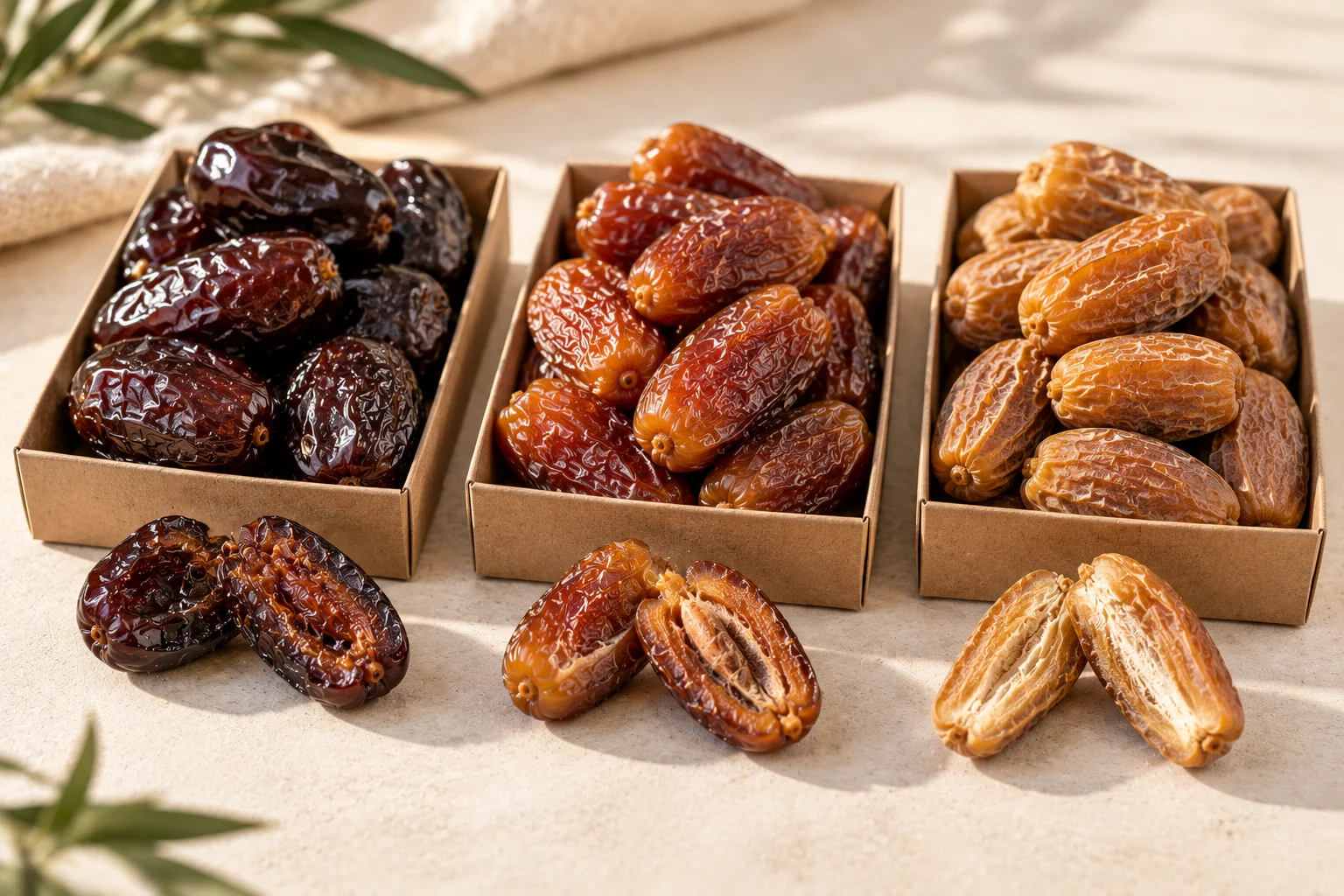
One more piece of vocabulary decides whether a specification is read correctly at origin. Dates ripen through four stages: kimri (unripe and green), khalal (crisp and fully coloured, eaten fresh in producing countries), rutab (soft and partly browned) and tamr (fully cured, the stage at which almost all exported dates are packed). When a supplier quotes “rutab Mazafati”, they are describing a fruit with a materially shorter shelf life and a stricter chain than tamr. Ask which stage is being offered.
The five varieties that cover most European demand
Medjool — the premium benchmark
Medjool originates from the Bou Denib oasis in Morocco, where Bayoud disease devastated the plantations in the twentieth century and pushed commercial production outward. Today the volume that reaches Europe comes mainly from Israel and the Jordan Valley, California, and increasingly from Peru, South Africa and Namibia — the southern-hemisphere origins arriving in counter-season, which is commercially useful for buyers who want year-round continuity of one variety.
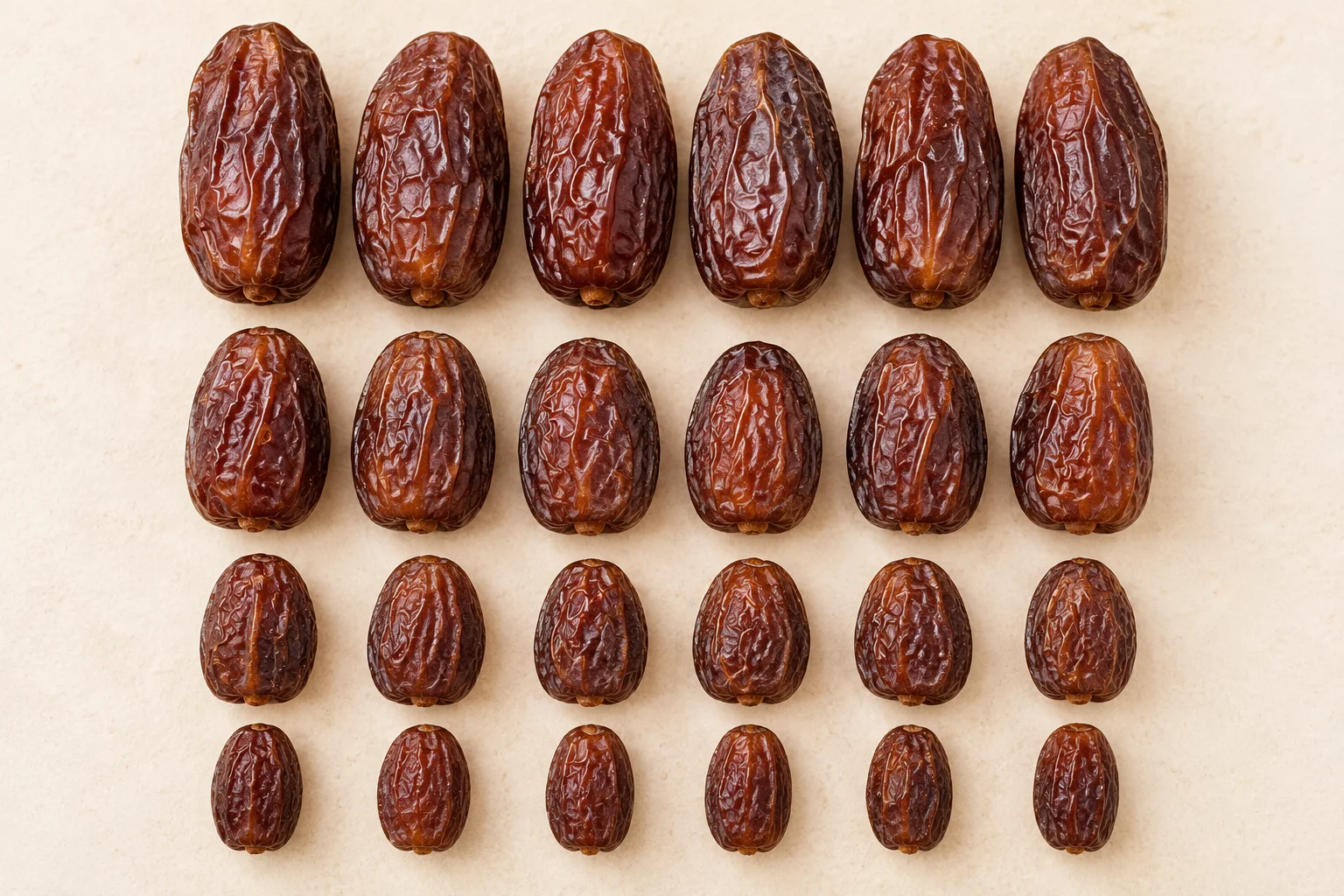
Medjool is large, fibrous in a pleasant way, and sweet without the caramel depth of the Iranian semi-dry varieties. It is graded by size rather than by quality class, and size is where most of the price sits. Indicative counts vary by packer, so confirm them against the specification rather than the name:
| Medjool grade | Indicative weight per fruit | Indicative count per kg | Typical destination |
|---|---|---|---|
| Jumbo / Extra Large | 22–26 g | up to ~45 | Gifting, premium retail trays |
| Large | 18–21 g | ~45–55 | Mainstream premium retail |
| Medium | 14–17 g | ~55–70 | Retail multipacks, food service |
| Small | 11–14 g | ~70–90 | Food service, stuffing, processing |
The commercial trap with Medjool is that the visual grade drives the price far more than the eating quality does. A Medium Medjool from a careful packer will often eat better than a Jumbo from a careless one, at a substantially lower landed cost. If the product is going into a sealed multipack rather than a clear gifting tray, buying down one grade is usually the single largest saving available on a Medjool order.
Deglet Nour — the mainstream European workhorse
Deglet Nour comes from Algeria and Tunisia, and its name — “date of light” — refers to the translucent amber the flesh shows when a fruit is held against a light. It is firm, less sweet than the soft varieties, and closer to a dried fruit than a confection in the way it eats.
It is the default retail date across much of Western Europe and dominant in France, where the historical trade links to the Maghreb built a consumer base that expects Deglet Nour specifically. It is also the variety most often presented on the stem — the branch or sur branche format — which remains a recognisable premium cue in French and Belgian retail despite adding weight and volume to the pallet.
For buyers, Deglet Nour has three practical advantages. It travels and stores at ambient temperature in a cool warehouse, which removes the cold-chain cost entirely. It pits cleanly and holds its shape after pitting, which makes it the usual choice for pitted retail packs and food service. And because Tunisia and Algeria hold preferential access to the EU under their association agreements, the duty position is generally more favourable than for Middle Eastern origins — a difference that can outweigh a lower FOB price from elsewhere. Confirm the current rate in TARIC against the specific CN code and origin before you model the landed cost.
Mazafati — the cold-chain variety
Mazafati is grown mainly around Bam and Jiroft in Iran’s Kerman province, and is sold in some markets under the name Kimia. It is very dark, almost black, glossy, and soft enough to mark under a thumb. Moisture typically runs from 32 to 35 per cent, and that single figure dictates everything else about how it is handled.
Mazafati requires a chilled or frozen chain from packing to shelf. At −18 °C it holds for a year or more with no meaningful change. At 0–4 °C it holds for a matter of months. At ambient European warehouse temperature it begins to ferment and darken within weeks, and a pallet left on a loading dock over a warm weekend can be written off. Any importer quoting Mazafati without a chilled chain in place is quoting a problem rather than a product.
Where that chain exists, Mazafati is a strong performer. Demand is concentrated in ethnic and halal retail, in Middle Eastern and Iranian diaspora communities across the Netherlands, Germany, Belgium and France, and it rises sharply in the weeks before Ramadan. It is a specialist line with a loyal customer base, not a general retail date.
Piarom — the semi-dry premium alternative
Piarom, also called Maryami, is grown in the Hajiabad region of Hormozgan province in Iran. It is long and slender rather than plump, dark brown, thin-skinned, and carries a pronounced caramel and molasses character that many buyers prefer to Medjool once they have tried it side by side.
Its commercial argument is the combination of a premium eating profile with semi-dry handling. At roughly 15 to 18 per cent moisture, Piarom stores at ambient temperature and carries a long shelf life, so it delivers a premium product without the cold-chain cost that Mazafati imposes. It also sits naturally in health-positioned ranges, where the low moisture, the absence of any need for added glucose or glazing, and the high mineral content support the claims a natural-sugar or wholefood brand wants to make.
The constraint is recognition. Piarom has very little consumer awareness in Western Europe, which means it needs either a strong in-store explanation or a channel where the buyer rather than the shopper is making the choice — food service, manufacturing, or a curated wholefood range. As a straight shelf substitution for Medjool in mainstream retail it usually underperforms, not on quality but on familiarity.
Sayer — the industrial volume date
Sayer, also known as Stamaran, is grown chiefly in Khuzestan and is the highest-volume date export from Iran. It is semi-dry, amber to reddish brown, moderately sweet, and entirely unremarkable as a table date — which is precisely why it matters commercially.
Sayer is the raw material behind a large share of Europe’s date paste, date syrup, chopped and diced dates, and the date content of energy bars, breakfast products and bakery fillings. It is sold pitted and unpitted in bulk cartons, it stores at ambient temperature, and it is priced at a fraction of Medjool. For a manufacturer buying dates as an ingredient rather than as a product, specifying Medjool is almost always paying for an appearance that gets destroyed in the first processing step.
Zahidi occupies a similar industrial position — firmer, golden, slightly less sweet — and is worth quoting alongside Sayer when the application is tolerant of either.
The comparison in one table
Figures below are indicative commercial ranges rather than fixed values, and will shift with harvest, region and packer. Use them to shortlist, then confirm against the supplier’s specification sheet.
| Variety | Main origins | Texture class | Indicative moisture | Storage | Indicative shelf life | Relative price |
|---|---|---|---|---|---|---|
| Medjool | Israel, Jordan, USA, Peru, South Africa, Morocco | Soft (handles semi-dry) | 21–26 % | Chilled 0–4 °C preferred; ambient tolerated short-term | 6–12 months chilled | Highest |
| Deglet Nour | Tunisia, Algeria | Semi-dry | 20–24 % | Ambient, cool and dry | 12 months | Moderate |
| Mazafati | Iran (Bam, Jiroft) | Soft | 32–35 % | Frozen −18 °C, or chilled 0–4 °C | 12+ months frozen; months chilled | Moderate to high |
| Piarom | Iran (Hajiabad) | Semi-dry | 15–18 % | Ambient, cool and dry | 12–18 months | High |
| Sayer | Iran (Khuzestan) | Semi-dry | 15–18 % | Ambient, cool and dry | 12–18 months | Lowest |
Matching the variety to the channel
The same five varieties sort very differently once the question becomes who is buying and what they do with the fruit. This mapping reflects what actually moves through European distribution rather than what tastes best in isolation.
| Channel | First choice | Viable alternative | What drives the decision |
|---|---|---|---|
| Premium retail and gifting | Medjool Jumbo / Large | Piarom, where the range is curated | Visual size and uniformity; clear-window packaging |
| Mainstream grocery retail | Deglet Nour, pitted or on-stem | Medjool Medium in multipack | Ambient storage, familiar name, price point |
| Ethnic and halal retail | Mazafati | Sayer, Sukkari, Ajwa for religious occasions | Community preference; cold chain must exist |
| Food service and catering | Deglet Nour pitted, bulk carton | Medjool Small for stuffing applications | Pitted convenience, ambient handling, cost per portion |
| Industrial: paste, syrup, bars, bakery | Sayer pitted, bulk | Zahidi; Deglet Nour offcuts | Cost per kilo of sugar solids; appearance irrelevant |
| Health and wholefood positioning | Piarom | Medjool, unglazed and unpitted | No added glucose or glaze; clean-label story |
What the cold chain actually costs you
The gap between an ambient and a chilled variety is not only the reefer freight. It is the reefer container, the temperature-controlled warehouse slot, the chilled or frozen transport to each customer, and the fact that a portion of your customer base — small independent retailers in particular — cannot receive chilled goods at all. Before committing to Mazafati, test the chain end to end against three questions.
- Can every customer in the target channel receive and hold chilled stock? If a meaningful share cannot, the variety limits your distribution before it reaches the shelf.
- Does your warehouse have year-round chilled or frozen capacity, not only seasonal? Pre-Ramadan volume peaks are exactly when third-party cold storage is most expensive and hardest to book.
- What is the landed cost per kilo including the chain, not at FOB? A Mazafati that looks competitive at origin can land above an ambient premium variety once the chain is priced honestly.

Where the answer to any of these is uncomfortable, Piarom is the variety to look at: it delivers a premium eating experience at ambient handling, which removes the entire question. We covered the temperature and humidity side of this in more detail in our guide on how to store dates for a full season without losing grade.
Calibre, pitting and pack formats
Three specification points come up in nearly every date negotiation and are worth settling before the first price is quoted.
Pitting. Pitted fruit costs more per kilo because of the labour and the yield loss, and it carries a marginally shorter shelf life where the flesh is exposed. It is the right choice for food service, for any industrial application, and for retail packs aimed at convenience. Unpitted is standard for premium retail and gifting, where the intact fruit is part of the presentation. Specify the acceptable pit-fragment tolerance in writing — this is a common source of claims, and “pitted” alone is not a specification.
Calibre. Medjool is graded by size as set out above. The other four varieties are more often specified by count per kilogram or by a simple grade class that varies between packers, so always convert the offer into count per kilo before comparing two suppliers. Two quotations described as “Grade A” can differ by thirty per cent in fruit size.
Pack format. Bulk cartons of 5 kg and 10 kg are standard for food service and industrial buyers. Retail runs on 200 g, 400 g, 500 g and 1 kg trays or pillow packs, and the on-stem presentation remains specific to Deglet Nour. If you are going to private label, agree artwork and print lead times separately from the fruit — packaging is more often the critical path than the crop, a point we set out in the Ramadan 2027 sourcing timeline.
A fourth point deserves its own sentence. Some suppliers apply a glucose syrup coating to improve gloss and to soften fruit that has dried beyond its target moisture. It is legal and declared, but it changes the ingredient list from a single item to two, and it disqualifies the product from most clean-label and wholefood ranges. If your positioning depends on a one-ingredient declaration, state “no glucose coating, no glazing agent” in the specification rather than assuming it.
Where the price differences come from
Buyers frequently assume the price gap between varieties reflects eating quality. It mostly reflects four other things.
- Yield and fruit size. Medjool palms produce fewer kilos per tree than the volume varieties, and the large-calibre fruit within that crop is a limited share of it. The Jumbo premium is a scarcity premium.
- Labour intensity. Medjool is hand-harvested in multiple passes and hand-graded. Sayer is harvested and handled at a scale that industrial pricing depends on.
- Duty and trade agreements. Tunisian and Algerian origins hold preferential access to the EU that Iranian origins do not, which can move the landed comparison by several percentage points independently of the FOB price.
- Chain cost. The refrigerated requirement behind Mazafati is real money in freight, storage and distribution that never appears in the origin quotation.
The practical consequence is that the cheapest date for a given job is frequently not the one with the lowest price per kilo at origin. Model the landed cost per kilo of usable product, after pitting yield and after the chain, and the ranking often changes.
What to do this month
If you are building or revising a date range for 2027, three steps are worth taking before the Ramadan sourcing window closes in late November.
- Sort your customers by texture group first. Establish how much of your book can physically handle a chilled product. That single number decides whether Mazafati belongs in your range at all.
- Request samples of Piarom alongside Medjool. If a meaningful part of your premium volume can move to an ambient variety, the saving runs through freight, storage and distribution, not just the purchase price.
- Separate your industrial and retail specifications. If you are currently buying one variety for both, you are almost certainly over-specifying the industrial half. Sayer at industrial pricing against Medjool at retail pricing is the largest single line-item saving most mixed buyers have available.
Plusimpex supplies all five varieties covered here in bulk and retail formats, with specification sheets, samples and landed-cost quotations by origin. Tell us the channel and the format and we will come back with the varieties that fit it.
Request a date specification and quotation — or browse our dates and dried figs range.
Frequently asked questions about date varieties
Which date variety is best for retail in Europe?
For mainstream grocery retail, Deglet Nour remains the default across most of Western Europe and is dominant in France and Belgium: it stores at ambient temperature, the name is familiar to shoppers, and the price point suits a weekly shop. For premium retail and gifting, Medjool in Large or Jumbo grade is the benchmark. The choice between them is usually a shelf-price decision rather than a quality one.
Do Mazafati dates really need refrigeration?
Yes. At 32 to 35 per cent moisture, Mazafati ferments and darkens at ambient European warehouse temperature within weeks. It should be held frozen at −18 °C for long storage, or chilled at 0–4 °C for shorter periods, and the chain needs to hold from packing through to the retail shelf. If any link in your distribution cannot maintain that, choose a semi-dry variety instead.
What is the difference between Piarom and Medjool?
Medjool is larger, plumper and softer, with a familiar name and the highest price. Piarom is long and slender, darker, with a pronounced caramel character and a much lower moisture content of roughly 15 to 18 per cent, which means it stores at ambient temperature. Piarom offers a premium eating profile without the cold-chain cost, but it has far less consumer recognition in Western Europe, so it performs better in curated, food-service and manufacturing channels than in a straight shelf substitution.
Which date should I use for date paste or energy bars?
Sayer, pitted and in bulk cartons, is the standard industrial choice, with Zahidi as an alternative where the application tolerates a firmer fruit. Both are priced well below the table varieties, and since the fruit is broken down during processing, the appearance you would pay for in a Medjool is lost in the first step.
Are dates halal-certified, and is certification needed for import?
Dates are a plant product and are inherently permissible, so certification is not a customs requirement for import into the EU. It is, however, frequently requested by retail buyers for Ramadan ranges, particularly where a glucose coating or glazing agent has been used or where the fruit is packed on lines shared with other products. If you are selling into ethnic or halal retail, treat certification as a commercial requirement even though it is not a regulatory one.